Fixing bamboo poles to the ground seems simple, but the durability of the anchoring depends on parameters that most tutorials overlook: the nature of the soil, the treatment of the buried area, and the type of connector used. Bamboo, a cylindrical and hollow material, does not react to mechanical stresses like solid wood. Its fixation to the ground requires solutions adapted to its geometry and sensitivity to moisture.
Metal Plates and Bases: The Anchoring That French Guides Omit
French-speaking articles often recommend driving bamboo directly into the ground or stabilizing it with concrete. This approach poses a fundamental problem: the direct contact between bamboo and soil accelerates degradation, even on treated bamboo. Moisture rises through capillarity in the fibers and weakens the base in just a few seasons.
The technical guidelines published by INBAR after 2022 detail the use of specific metal bases and plates for bamboo. The principle is to isolate the culm from the ground by fixing it to a metal support that is itself anchored in a foundation. The minimum anchoring depth varies according to the type of soil and wind exposure.
The most reliable method for fixing bamboo to the ground relies on a galvanized steel plate screwed into a concrete block, with a cylindrical sleeve that matches the diameter of the section. The bamboo is then bolted through the sleeve, preventing any lateral movement without compressing the fibers.
Treatment of Anchoring Areas: Alternatives to Toxic Products
For a long time, treatments based on copper, chrome, or boron salts were the norm for protecting bamboo in contact with the ground. European regulations on construction biocides have changed the game.
Since 2023, European suppliers (notably in Germany and the Netherlands) offer treatments without heavy salts for anchoring areas. Two families of products stand out:
- Modified vegetable oils, derived from linseed or tung, combined with a thermal treatment process that penetrates the fibers deeply and creates a durable hydrophobic barrier
- Bio-sourced resins or hydrophobic polymers, applied only to the buried portion of the bamboo, which form a protective film without migrating into the surrounding soil
- Surface carbonization treatments of the base (a technique inspired by Japanese yakisugi), which reduce the porosity of the fibers and repel wood-eating insects
These bio-sourced solutions offer protection comparable to older biocides while respecting recent environmental constraints. Field feedback varies on this point: some builders believe that longevity remains inferior to that of boron treatments, while others report satisfactory results after several years of exposure.
Unstable Soils and Frost: Adapting Fixation to the Terrain
An effective anchoring on sandy or clayey soil is not conceived the same way as on rocky terrain. Frost is the most underestimated threat to bamboo fixations in temperate climates.
When the ground freezes, it expands and lifts the surface blocks. Upon thawing, the block settles back down, but rarely to its original position. This phenomenon of frost heave, repeated every winter, gradually destabilizes the structure.
For frost-prone soils, the foundation must extend below the local frost line. In regions where the ground freezes deeply, this means pouring a concrete block deeper than for a standard wooden terrace. The metal sleeve fixed at the top of the block allows for connecting the bamboo without burying it.
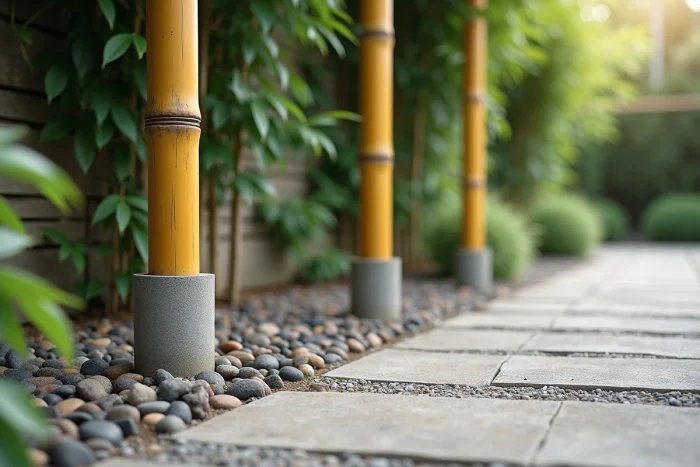
On clayey soils, the problem reverses in summer: the shrinkage of the clay due to drying creates voids around the anchoring. One solution is to surround the block with a layer of draining gravel that stabilizes contact with the ground and limits seasonal movements.
Drilling and Bolting Bamboo: Avoiding Splitting
Bamboo splits easily when drilled without caution. Its longitudinal fibrous structure promotes the propagation of cracks from the drill hole, especially near the nodes.
Three technical rules reduce the risk of splitting:
- Use a suitable diameter auger or wood bit, never a masonry bit, and drill at moderate speed without forcing
- Position the bolting holes immediately next to a node (the wall is thicker and more resistant there) rather than in the middle of an internode
- Place a wide washer between the bolt head and the bamboo surface to distribute the pressure and prevent tightening from splitting the fibers
Drilling near a node reduces the risk of cracking several times compared to drilling in a regular section. This detail, rarely mentioned in assembly guides, makes a major difference in durability.
Through-bolting (a threaded rod passing through both walls of the bamboo with washers on each side) remains the strongest technique for fixing a vertical section to a plate. The tightening should be firm without being excessive: too tight bamboo splits, while insufficiently tight bamboo vibrates in the wind.
The choice between direct anchoring, a metal sleeve, or bracing depends on the project, but also on the soil, climate, and diameter of the sections. Structures exposed to wind or located in frost zones clearly benefit from a plate-sleeve system with a deep foundation. For a sheltered decorative trellis, a lighter anchoring may suffice, provided that the base of the bamboo never touches bare earth.