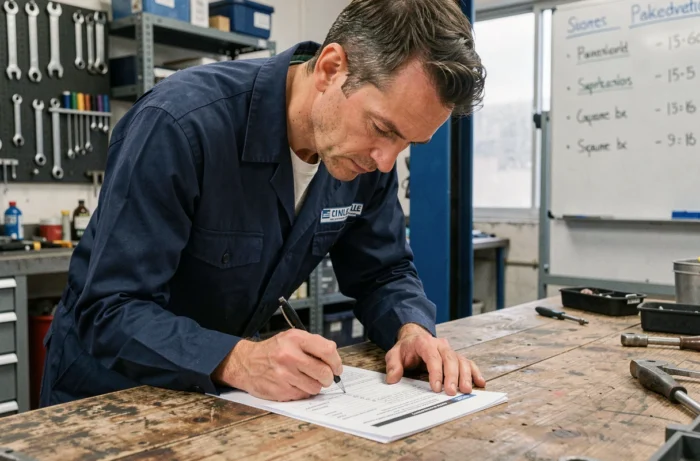
In an automotive garage, the traceability of interventions relies on precise documents. The blank automotive repair order remains the basic support to formalize the client’s request, record the vehicle’s condition upon arrival, and frame the work to be done. Neither strictly mandatory nor trivial from a legal standpoint, this form occupies a special place in workshop management.
Legal obligation of the automotive repair order: what the texts say
No text formally imposes the drafting of a repair order. Decree No. 78-993 of October 4, 1978, governs the garage-client relationship but does not make this document systematic. However, two constraints do apply.
First, a mechanic cannot refuse the repair order if the client requests it. Secondly, once such a document exists, it must mention the mileage on the odometer. This is a requirement of the same decree, and its absence weakens the evidentiary value of the form in case of a dispute.
From a civil standpoint, Article 1353 of the Civil Code places the burden of proof on the party claiming payment. For a garage, this means that in case of a dispute, it will need to demonstrate that the billed work was indeed ordered by the client. A signed repair order then constitutes the strongest piece of evidence. Professionals wishing to delve deeper into this point can learn more on Ct Automobiles, which details the formalization process.
Parts from the circular economy: the mention effective from October 1, 2024
Since Decrees No. 2024-823 and 2024-824 of July 16, 2024, garages must offer clients parts from the circular economy for certain categories of repairs. This obligation took effect on October 1, 2024.
On a blank repair order, this constraint translates into a dedicated area: the client’s written choice regarding the type of accepted part. This is not a simple box checked afterwards on the invoice. The client must express their choice before the start of the intervention, and the repair order is the natural document to collect this agreement.
A blank model that does not include this section is therefore incomplete in light of current regulations. Forms prior to this date deserve an update.
Content of a blank repair order model: the important sections
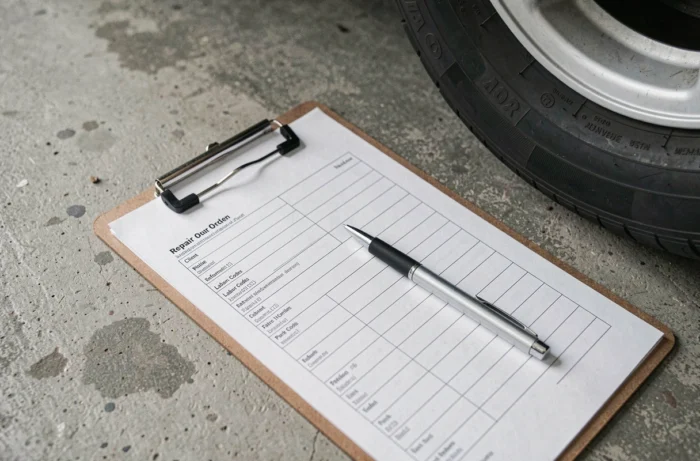
A blank automotive repair order generally fits on one page. Not all fields have the same legal significance or operational utility. Three categories stand out.
Identification and condition of the vehicle
- Registration, make, model, serial number: this information identifies the vehicle unambiguously and avoids any confusion in a workshop managing multiple simultaneous entries
- Mileage on the odometer: a mention required by the 1978 decree, it protects against accusations of unauthorized driving
- General condition upon receipt (scratches, dents, items left in the cabin): this section falls under the deposit contract as per Articles 1915 and following of the Civil Code, with the garage being the custodian of the vehicle during the intervention
Client request and spending limit
The request must be recorded in the client’s words, not rephrased in technical jargon. A client saying “it vibrates when braking” does not necessarily request a change of discs. Noting the description of the symptom rather than the presumed diagnosis avoids misunderstandings about the scope of authorized work.
The spending limit, sometimes referred to as the expenditure ceiling, sets the amount beyond which the garage must contact the client before proceeding. Without this mention, the professional risks charging for unapproved work.
Choice of parts and signature
The section regarding circular economy parts has been mentioned above. The client’s signature, affixed before the start of the work, transforms the document into proof of agreement. Without a signature, the repair order loses its evidentiary value and reverts to a simple internal voucher.
Repair order and automotive estimate: two documents, two functions
The confusion between repair order and estimate often arises. The repair order records the request and the condition of the vehicle. The estimate precisely quantifies the work to be done and commits the garage to a price once accepted by the client.
In practice, a garage can use the repair order to formalize an initial diagnosis, then establish a detailed estimate before undertaking additional repairs. This two-step sequence is particularly suited for troubleshooting, where the scope of the intervention is not known upon the vehicle’s reception.
A well-designed blank model includes an estimation area, but this estimation does not replace a formal estimate when the amount exceeds the agreed threshold.
Electronic invoicing and workshop management: anticipating the transition
The schedule for the electronic invoicing reform stipulates that the affected businesses can start receiving electronic invoices from September 1, 2026. Very small enterprises and micro-enterprises will need to issue their own starting from September 1, 2027.
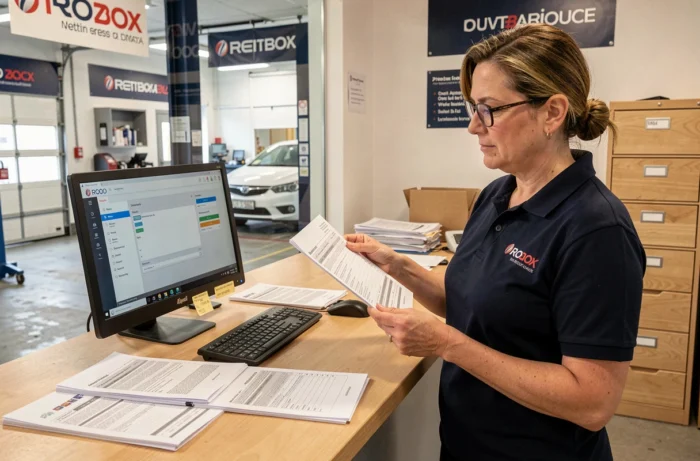
A digital repair order, filled out on a tablet or computer, facilitates the transfer of information (vehicle identification, parts used, labor hours) into the management software. The paper form remains valid, but it involves manual re-entry, which multiplies the risk of errors and slows down the administrative chain.
The repair order does not serve as an invoice. It feeds into the invoice. A workshop preparing for its transition to electronic invoicing should structure its blank repair orders with fields compatible with its management software, so that the transition from the form to the invoice occurs without complete re-entry.
Structuring a blank automotive repair order around current requirements (mileage, choice of parts, spending limit, signature) protects both the garage and the client. The form remains a simple tool, provided that each section corresponds to a specific legal or operational function.