Regulations sometimes impose strict protocols for calculating surfaces, but the method will mainly depend on the intended purpose: estimating for an upcoming project, administrative procedures, or simple personal assessment. However, the difference between living area and wall area continues to cause confusion, even though they are two distinct realities.
Digital tools are now changing the game and making these calculations, once laborious, much more accessible. Several solutions exist to obtain accurate results without resorting to complex formulas or mastering architecture down to the last detail.
What is the real purpose of calculating a facade’s surface?
Determining the surface area of a facade is not just an administrative detail. This measurement dictates the amount of materials to be planned: render, insulation, cladding, it all hinges on this. A simple error in your calculations can quickly lead to a cost overrun to absorb, delivery delays, or a project that drags on due to insufficient stock. Failed projects often start with a hasty estimation of square meters.
Construction professionals, architects, or informed individuals: calculating the surface area of a 100m2 house facade remains the foundation for ordering the right amount of paint, plaster, or insulating panels. But precision does not stop at logistics. When it comes to obtaining a quote, accurate measurements protect against disagreements with companies and avoid unpleasant surprises on the final bill.
In the context of energy renovation, the surface to be rendered plays a key financial role: it serves as a reference for aids and subsidies. Local or national organizations often require precise justifications for the treated surfaces. The house then becomes a measurement object, where every square meter counts and must be demonstrable. Rigor is paramount: it is the condition for a successful project that stands the test of time.
Differences between living area, wall area, and other concepts to know
Confusing living area, wall area, and other regulatory concepts remains common, but each measurement has its own logic: sale, renovation, subsidy application, nothing is calculated at random.
The living area corresponds to the living spaces, according to the famous Boutin law. Only spaces with a ceiling height exceeding 1.80 m are taken into account. Basements, garages, parking spaces, verandas: all of this is excluded. This figure is used in rental or sale. For the Carrez law, the calculation concerns condominiums, taking into account enclosed and covered areas while also excluding unconverted attics, garages, and parking spaces. The slightest approximation can lead to significant legal consequences.
On the other hand, the wall area concerns all exterior walls: this is the figure to remember for rendering or insulation. Here, there is no need to worry about ceiling heights or distinguish between rooms: it is the length and height of the walls that matter. To avoid mistakes, always ensure you are using the correct measurement, whether it is for a real estate transaction, construction, or renovation project. The accuracy of the data determines the effectiveness of the project.

How to easily obtain the surface area of your facade: simple methods and practical tools
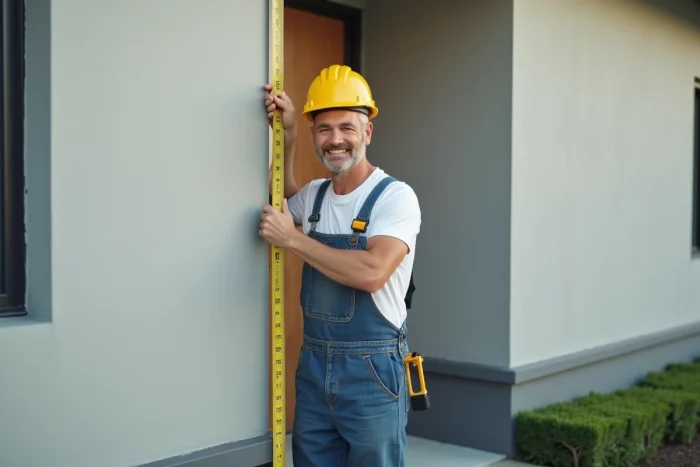
Determining the surface to be rendered or renovated is not improvised. You need to start with the basics: take out the tape measure, carefully measure each wall noting width and height, then multiply these figures. Do this for each facade, add the results, and you will obtain the total surface area.
To save time, laser distance meters offer appreciable accuracy, especially for measuring height when the ladder reaches its limits. There are also mobile applications: a photo, a few indications, and the tool calculates for you.
To properly adjust your estimate, keep this detail in mind: you need to subtract the surface of the openings (doors, windows, sliding doors). This avoids buying too many materials and unnecessarily inflating the quote.
For more complex projects, some prefer to call in a surveyor or a geomatics professional. Their paid intervention guarantees impeccable measurements, which can prove invaluable on large projects or during a transaction.
In the professional sector, specialized software allows for simulating and optimizing the surfaces to be treated. These more technical tools are suitable for projects where every detail counts. As for artisans, they combine experience and method, with a keen eye to adjust calculations to the reality on the ground.