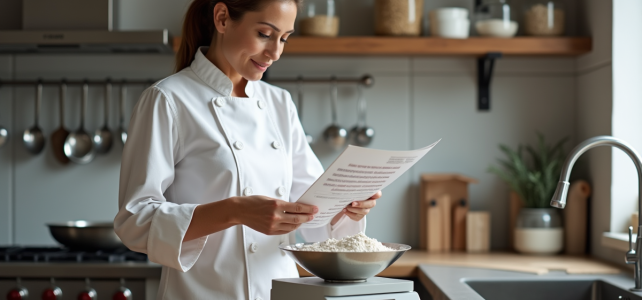
One gram of flour never occupies the same volume as one gram of sugar. The density of ingredients varies, disrupting the classic equivalences between milliliters and grams. International recipes impose different units, forcing one to juggle between cups, spoons, and kilograms.
In this diversity of measurements, the success of a dish often depends on precise conversions. Appropriate tools and a few reliable benchmarks help avoid common mistakes. Professionals rely on charts and scales to the nearest gram to ensure consistent results.
See also : Online Tarot: Between Spiritual Guidance and Digital Entertainment
Why conversions between liquids and solids are essential in cooking
In the realm of precision cooking, every measurement matters. It’s impossible to hope for a crispy shortcrust pastry or a fluffy brioche if the conversions between liquids and solids go awry. Translating a volume to weight is not to be taken lightly: even a small difference in milliliters can disrupt the texture of a cake or the creaminess of a sauce. Faced with a recipe that calls for one hundred milliliters of water or two hundred grams of flour, how can one aim accurately?
Ensuring to weigh solid and liquid ingredients accurately is fundamental for achieving consistent results. Water, milk, oil, cream, all have different densities: 100 ml of oil does not equal 100 grams. Knowing how to juggle the milliliters-grams conversion quickly becomes essential, especially for those who leave nothing to chance, both amateurs and professionals. Recipes from abroad further complicate matters, multiplying the units: liters, centiliters, sometimes cups or spoons.
See also : Technology and Pedagogy: Campuses Redefining Higher Education
To navigate this maze, there are reliable solutions. For example, the page 250 ml to grams provides concrete benchmarks to accurately convert your quantities of ingredients, whether it’s flour, sugar, or liquids. This type of resource avoids guesswork and secures every step of the recipe.
Knowing how to handle measurements opens the door to inventive cooking, without sacrificing the reliability of the outcome. Mastering these conversions is not just a technical skill: it guarantees successful recipes, true to the original as well as to your own adjustments.

Concrete examples and clever tools to succeed in all your conversions
It all starts with reliable measuring instruments. A measuring cup graduated in milliliters makes a difference for precisely measuring the volume of milk or oil. For dry ingredients, nothing beats a kitchen scale: it converts volume to weight in one simple move, removing doubt when preparing your recipes.
Here are some useful benchmarks for converting from one unit system to another:
- 1 cup = 250 ml
- 1 tablespoon = 15 ml
- 1 teaspoon = 5 ml
Thanks to these equivalences, adapting an American, English, or Australian recipe becomes child’s play. Units of measurement change depending on the country: relying on a conversion chart or a practical guide helps avoid unpleasant surprises, whether for a Sunday cake or a pressure service.
Another advantage: some mobile applications specialized in culinary conversions help instantly transform the quantities of flour, sugar, water, or milk according to the recipe. They memorize common conversions and slip in a few practical tips along the way. The experience sharpens over time with trials, tools, and time spent in the kitchen: precision eventually becomes second nature, and the results follow suit.
Mastering the art of conversions gives each dish the chance to reveal its full potential and turns every recipe into a promise kept.