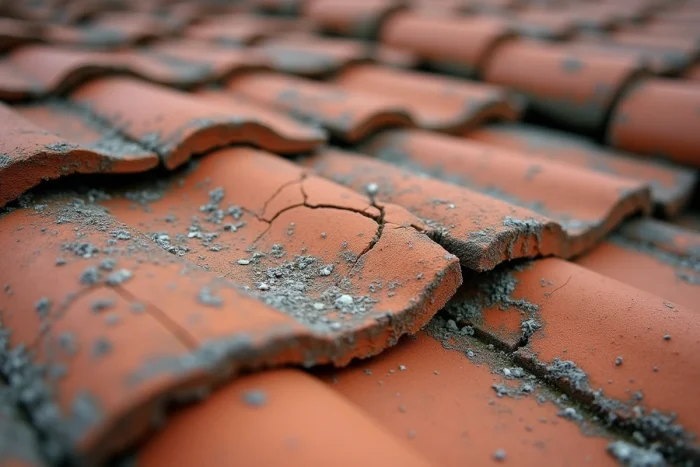
A crack in a tile does not always manifest the same way depending on the material, the age of the roof covering, and the area of the roof in question. Understanding the cracking mechanism before intervening prevents unnecessary repairs and short-term recurrences.
Concrete tiles from the 1980s-1990s: a formulation aging to watch
Roofers specialized in renovation observe an increased frequency of cracks in concrete tiles installed between 1980 and 1990. The formulation of these tiles, often less stable than that of subsequent generations, leads to a gradual degradation of the cement binder. The result: micro-cracks on the surface that widen due to freeze-thaw cycles, sometimes without visible signs from the ground.
This phenomenon should not be confused with simple weathering. We regularly observe roofs from this period where only the concrete tiles are affected, while the terracotta elements of the same roof remain intact. A precise diagnosis of the material is therefore the first step before any intervention.
On this type of covering, looking for solutions to repair a broken tile with sealant often amounts to masking a structural problem. When the concrete formulation is at fault, batch replacement remains the only sustainable solution.
Cracks related to wildlife: an underestimated diagnostic factor
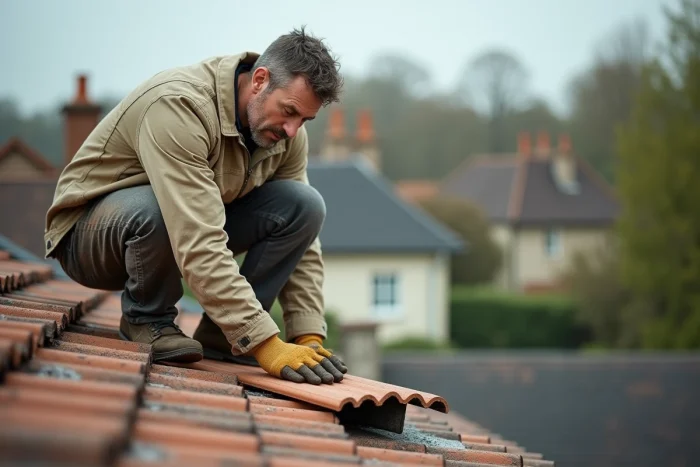
Diagnostic grids now include wildlife damage as a legitimate cracking factor. Weasels moving under the covering, birds lifting or displacing the tiles, rodents weakening the battens: these repeated mechanical aggressions create localized stresses that are easily confused with natural aging.
The distinguishing feature: clustered cracks in a restricted area, often at the edge or bottom of the slope, where wildlife can access most easily. If you notice this type of concentration, an inspection of the under-roof is necessary before replacing the tiles. Without addressing the cause (installing intrusion grids, sealing access points), the new tiles will suffer the same stresses.
Signs to look for during inspection
- Scratch marks or wear on the inner face of the removed tiles, indicating repeated passage of an animal
- Rotted or notched battens in the cracking area, which alters the tile’s support and causes abnormal bending
- Presence of droppings or nesting materials in the attic, correlated with the location of the damaged tiles
Hail and micro-impacts: cracks invisible from the ground
Intense hail episodes have led to a sharp increase in claims for cracked tiles since 2022, particularly in the southeast and southwest quarters of France. The most insidious phenomenon remains the micro-impact: multiple small cracks, invisible to the naked eye from the ground, that only reveal themselves during the first freeze or heavy rain.
We recommend a close inspection after every hail episode, even moderate ones. A micro-cracked tile retains its exterior appearance but loses its watertightness. Water infiltrates by capillarity, reaches the batten, then the framework, and the diagnosis often comes too late.
Insurance and spot repair: what has changed
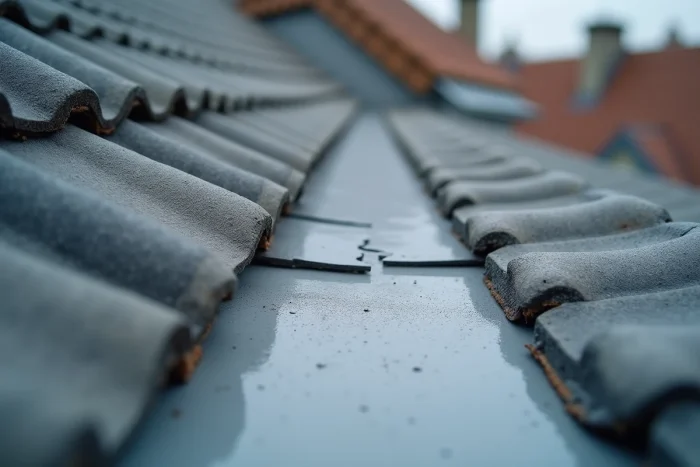
Insurance companies are increasingly reluctant to accept spot repairs (sealant, localized water-repellent product) as a sustainable solution in the event of a new claim in the same area. Tile replacement is now favored as soon as it concerns a sensitive area: ridge, valley, or abutment. If you report a hail claim, document each affected tile with close-up photos. A simple patch may deprive you of coverage during a future incident.
Repair or replacement of tiles: technical decision criteria
The question is not whether a crack “can” be repaired with sealant or resin, but whether this repair makes sense for the remaining lifespan of the covering. We apply a simple rule: a cracked load-bearing tile in the main drainage area should be replaced, never patched.
Patching remains relevant in only one case: a superficial crack on a field tile, outside the concentrated runoff area, on a roof less than twenty years old. In this configuration, a polyurethane sealant applied to a dry and degreased tile can last several years.
Factors guiding the decision
- Position of the tile: a tile in a valley or abutment experiences much higher water volumes than a field tile; even the slightest crack becomes critical
- Material and age: on a concrete tile from the 1980s, patching makes no sense if the binder is generally degraded
- Condition of the underlying batten: a damp or partially rotted batten indicates an old infiltration; simply replacing the tile will not be sufficient
- Consistency with insurance: if the area has already been subject to a claim, a complete replacement is more defensible than a series of repairs
Roof water-repellent: preventive treatment or false security
The application of a water-repellent on porous tiles frequently appears in roofer quotes. This treatment has real utility on aging terracotta tiles whose porosity increases over time. It slows water absorption and limits freeze damage.
However, a water-repellent does not seal an existing crack. We see too many roofs treated with water-repellent while cracked tiles should have been replaced beforehand. The product waterproofs the surface, but water continues to penetrate through the crack, with a perverse effect: it takes longer to drain, which worsens damage to the batten and insulation.
A water-repellent treatment only makes sense after replacing all cracked tiles and checking the condition of the battens. It is a finishing touch at the end of the project, not a substitute for repair.