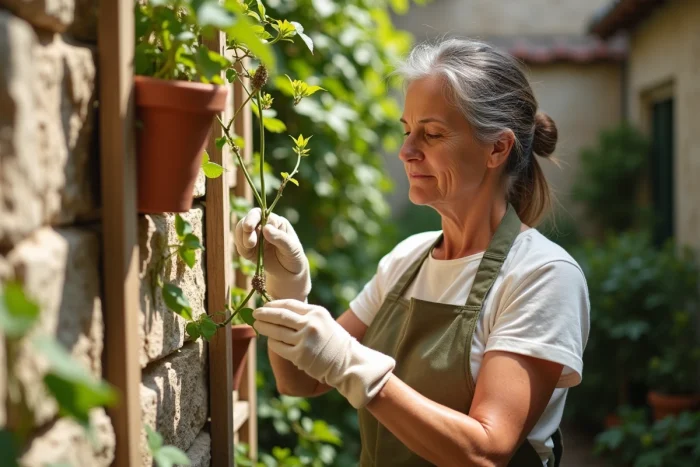
The star jasmine (Trachelospermum jasminoides) is a climbing plant with evergreen foliage that does not cling to a wall on its own. Unlike ivy or virginia creeper, its twining stems need a support to wrap around. Without guidance or attachment, the plant crawls on the ground or forms a messy bush at the foot of the wall.
Gap between the support and the wall: a detail that changes everything
Many gardeners attach their trellis directly against the facade. The star jasmine then grows with foliage pressed against the wall, which retains moisture and promotes fungal diseases.
The best practice is to leave about 4 to 5 cm between the support and the wall. This space allows air to circulate behind the foliage and facilitates maintenance. Wooden wedges, metal spacers, or simple cork stoppers screwed between the trellis and the wall are enough to create this gap.
This principle applies equally to a stone wall, a wooden fence, or a pergola post. If you want to know how to attach a climbing jasmine on Bricotronique, you will find a supplementary guide on choosing the right support for your setup.
Fan training of star jasmine: the method that promotes flowering
The most common reflex is to guide the main stem vertically. The star jasmine then grows in a single axis, with few lateral branches and flowering concentrated at the top of the support, out of visual and olfactory reach.
Principle of fan training
Fan training is based on a simple horticultural logic: when a stem is oriented horizontally or diagonally, it produces more lateral branches. These branches bear the flower buds. The more the plant branches, the more it flowers across the entire surface of the support.
The method involves selecting two or three vigorous stems from the first year, then attaching them diagonally, to the left and to the right, to gradually cover the entire width of the trellis.
Suitable ties and fasteners
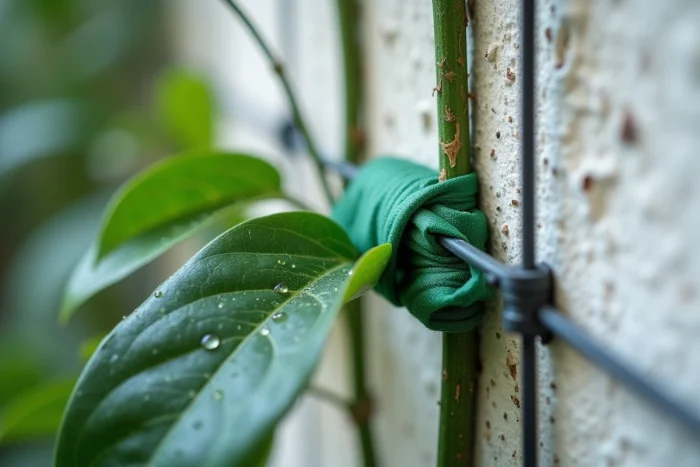
The choice of attachment tie has a direct impact on the health of the stems. A wire or a rigid plastic collar can strangle the stem within a few months of growth.
- Soft ties made of raffia or jute degrade naturally and do not harm the bark, but they need to be replaced each season
- Stretchable rubber ties accommodate the thickening of the stem without compressing it, and last two to three years
- Orchid clips are suitable for young thin shoots, but become too small as the plant matures
In all cases, the tie forms a figure eight between the stem and the support, never a tight link around the stem alone. This eight-shaped loop absorbs movements caused by the wind without rubbing the bark.
Planting mistake that hinders the growth of star jasmine
A star jasmine properly installed on a good support but not growing is often the victim of an invisible error: the collar buried too deeply. The collar is the transition zone between the roots and the aerial stem.
When this zone is buried under several centimeters of soil or mulch, stagnant moisture causes slow rot. The plant survives, produces a few leaves, but never gains vigor. Whether in the ground or in a pot, the collar should be level with the soil surface.
Star jasmine in a pot: substrate volume as a criterion
In a pot, this climbing plant needs a container of at least 60 cm in height to develop a sufficient root system. A pot that is too small limits growth long before a lack of fertilizer or sunlight becomes an issue.
The substrate must be draining. A layer of clay balls at the bottom of the pot and a mixture of potting soil and perlite help prevent stagnant water at the roots. The pot should be placed against the wall or pergola, and the trellis starts just above the edge.
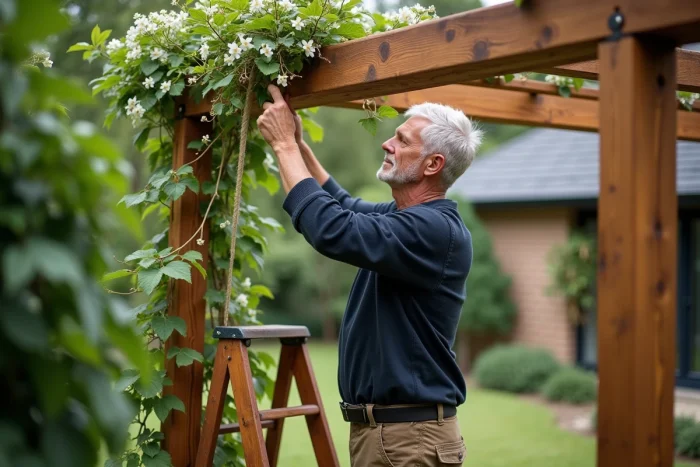
Seasonal maintenance to keep star jasmine on its support
Once the star jasmine is well installed and trained, maintenance consists of two interventions per year.
- After the main flowering (late summer), prune the stems that extend beyond the support and shorten those that cross to maintain the fan shape
- In spring, check each attachment point and replace worn ties before new growth becomes tangled
- Redirect new shoots to the bare areas of the trellis rather than letting them pile up at the top
Pruning after flowering is also the time to remove dead or overly woody stems at the base. A well-trained star jasmine covers a wall two meters wide in three to four years, provided that each new shoot is guided instead of being allowed to climb freely.
The star jasmine does not require a complex support system. A trellis set away from the wall, fan training from planting, and soft ties replaced each spring are enough to achieve a curtain of dense, fragrant foliage, both in the ground and in a pot on a balcony.