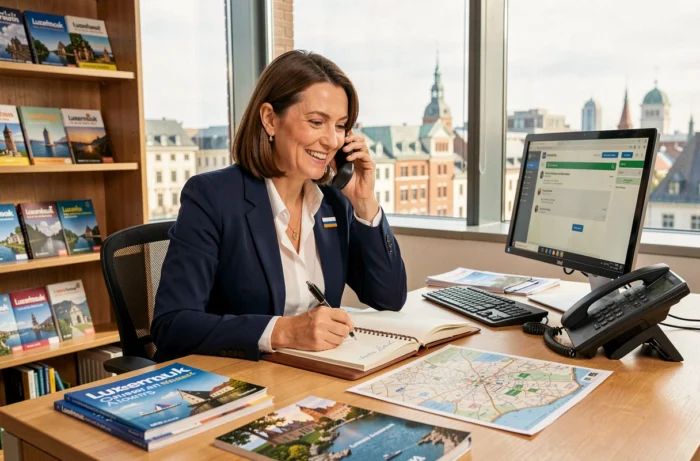
You’re planning a weekend in Luxembourg City. You’ve picked out the Bock Casemates and a couple of restaurants, then comes the practical question: who can bring it all together without you spending half a day trying to match up schedules? The obvious choice might be the tourist office, but it publishes programs without necessarily organizing the trip itself. A dedicated contact like Travel Guide lets you submit a specific request and get an itinerary tailored to your needs.
Why having a single point of contact makes planning a trip to Luxembourg easier
When you plan a trip that combines a guided tour, accommodation, and transportation, you end up dealing with multiple contacts. The tourist office provides general information, the tour operator handles its own bookings, and the transport provider has its own rules.
In Luxembourg, public transport (buses, trams, and second-class trains) is free within the country. Cross-border journeys and first-class travel, however, are still subject to a fare. If you’re coming from Metz, Trier, or Brussels, the cost of your cross-border journey isn’t covered by the free transport policy. Letting your organizer know your departure city from the outset helps avoid budget surprises.
A service like Travel Guide brings all these details together. You can contact Travel Guide using its online form to outline your plans: dates, group size, interests, and departure city. The response takes transport requirements, site availability, and tour times into account, so you don’t have to follow up with each provider separately.

Online form, phone, or email: which contact method to choose for your request
Not every contact method is equally suited to every request. An online form works well for a structured inquiry: you can describe the type of trip, its duration, and the number of visitors. The benefit is that you can write your request at your own pace, add details, and keep a written record of the exchange.
A phone call is better when you need a quick confirmation, for example to check whether a guided tour is available on a specific date. Some tours in Luxembourg don’t require advance booking, while others require registration to secure a place. Check the booking requirements before making plans to avoid reserving a time slot unnecessarily or, conversely, arriving to find the group is full.
Email works well for complex requests that require attachments (a draft itinerary, a participant list, or accessibility requirements). It also makes it easy to compare several offers if you’re contacting different providers at the same time.
What to include in your first message
- The exact dates of your trip and the number of people, including children if special rates apply
- Your departure city, so the provider can include cross-border transport in its proposal
- The sites or experiences you’re interested in (the Bock Casemates, the Old Town, Müllerthal), and whether you’d prefer a self-guided or guided visit
- Any scheduling or logistical requirements, such as needing to return by a certain time or requiring accessible facilities
A complete message from the outset cuts down on back-and-forth and speeds up the proposal.
The difference between a tourist office and a trip-planning service in Luxembourg
It’s easy to confuse the two. The Luxembourg City Tourist Office provides tour programs, event calendars, and brochures. It’s an information resource, not a service that organizes tailor-made trips. Ask explicitly who will provide the service when you consult a program on an official website.
A trip-planning service like Travel Guide works differently. It creates a personalized itinerary, coordinates bookings with local providers, and adjusts the program based on your feedback. The difference is like that between a noticeboard and a concierge: one shows you what’s available, while the other puts together what suits your needs.
This distinction has a practical impact on how long it takes to plan. If you go through a tourist office, you’ll then need to contact each provider individually. Using a dedicated organizer reduces this to a single initial exchange, followed by a consolidated proposal.

Planning a trip to Luxembourg: pitfalls to avoid before getting in touch
Not all guided tours use the same booking process. Some, such as regular tours of the Old Town, operate on a first-come, first-served basis. Others, particularly themed tours or art walks, require advance registration and may have limited spaces.
Failing to check this before putting together your itinerary can throw off an entire day. If a visit to the Bock Casemates is planned for a specific time and it’s fully booked, you’ll need to rearrange the rest of your schedule.
The pitfall of underbudgeting for a cross-border trip
As mentioned, free public transport doesn’t extend beyond the country’s borders. For a group coming from abroad, the cost of a round trip can account for a significant part of the budget, especially by train. Providing your departure location when you first get in touch allows the provider to suggest alternatives (organized carpooling or a shuttle from a border station) or simply include this cost in the quote.
Another often-overlooked factor is the length of your stay. Luxembourg City is easy to explore in a day if you’re focusing on the main sights, but the surrounding areas (Müllerthal, the Luxembourg Moselle, and the castles in the north) require at least one extra night. Clarifying whether your trip is a day excursion or a multi-day tour helps ensure the proposal is on the right track from the outset.
The easiest approach is to gather these details (dates, departure location, trip length, and interests) before sending your first message. A provider who receives a complete request can respond more quickly and accurately than one who has to follow up for basic information.