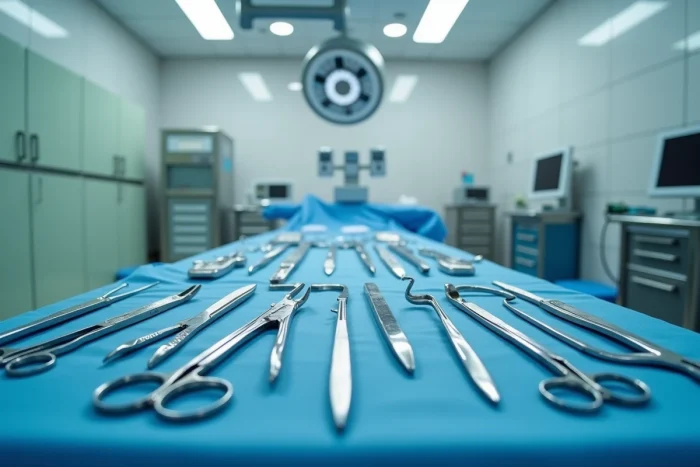
The operating room brings together a set of equipment, each piece fulfilling a specific function during the surgical intervention. From the operating table to the grasping instruments, the operating room materials are classified into functional families: cutting, hemostasis, exposure, suturing, and protection. Understanding this classification allows healthcare professionals to verify the compliance of a room before each procedure.
Ergonomics of Operating Room Equipment in Response to the Aging of Surgeons
The average age of practicing surgeons is steadily increasing. This demographic reality poses a concrete problem: less flexible hands, quicker musculoskeletal fatigue, and heightened sensitivity to vibrations from powered instruments.
Manufacturers are gradually adapting their ranges. Instrument handles are increasing in diameter to reduce the grip strength required. Forceps are incorporating softer ratchet mechanisms, and some scalpel handles are adopting textured non-slip coatings that limit tension in the forearm.
Motorized adjustable operating tables are replacing manual control models in a growing number of facilities. Patient positioning, which previously required significant physical effort, is now done via pedal or remote control. For ceiling-mounted distribution arms, the trend is towards articulated systems with pneumatic assistance, where moving a screen or cable column requires minimal pressure.
This ergonomic shift is not only about the comfort of the practitioner. A better-fitted instrument reduces the risk of imprecise movements, which translates to increased safety for the patient. Standard guides on operating room equipment rarely address this angle, even though it directly influences the choice of equipment in facilities where a significant portion of the staff has been operating for over twenty years.
For everything you need to know about operating room equipment and its recent developments, an in-depth reading of surgical instrumentation complements this ergonomic approach.
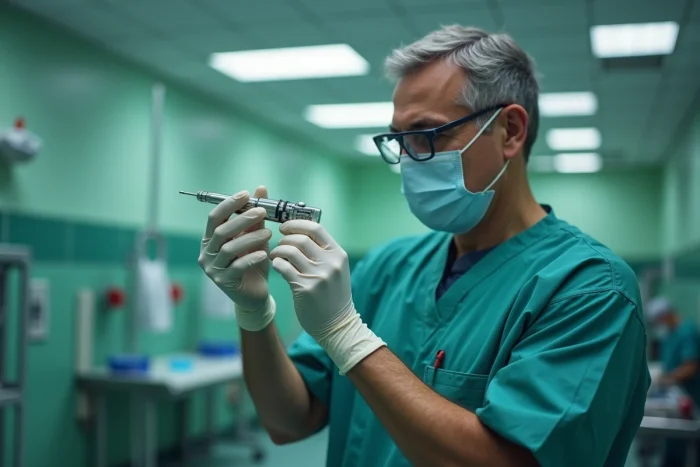
Surgical Instruments Classified by Function: Cutting, Grasping, Hemostasis
The functional classification remains the basis of any operating room checklist. Each category addresses a distinct surgical need.
- Cutting instruments: scalpels (cold and electric blades), Mayo scissors for thick tissues, Metzenbaum scissors for fine dissection. The choice of blade depends on the depth of incision and the type of tissue.
- Grasping instruments: dissecting forceps (with or without claws), Kocher forceps for tough tissues, Allis forceps for atraumatic traction of hollow organs. The serration and length vary according to the specialty.
- Hemostasis instruments: Halsted hemostatic forceps (mosquitoes) for small vessels, Kelly forceps for larger structures. Monopolar or bipolar electrocoagulation complements the mechanical arsenal.
- Exposure instruments: self-retaining retractors (Balfour, Finochietto) and manual retractors (Farabeuf, Langenbeck). They keep the surgical field open without mobilizing a team member.
- Suturing instruments: needle holders, absorbable and non-absorbable sutures, skin staplers. The gauge of the suture and the curvature of the needle are chosen based on the anatomical location.
The IBODE (State-certified operating room nurse) checks the presence and integrity of each instrument before and after the procedure. This counting, which is mandatory, prevents the forgetting of materials in the surgical site.
Fixed Equipment in the Operating Room: Oxygen, Lighting, Ventilation
Beyond the instrumentation handled by the surgeon, the operating room relies on fixed equipment that determines patient safety and the quality of the procedure.
Oxygen and Medical Gas Circuit
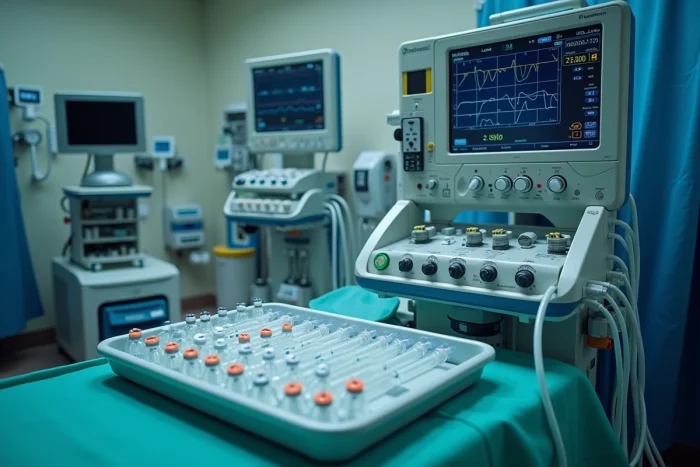
The standardized wall outlets deliver oxygen, nitrous oxide, and compressed air directly to the anesthesia station. The anesthesia station includes a ventilator, a vaporizer for halogen agents, and a multiparametric monitor (SpO2, capnography, invasive blood pressure). Any failure in the gas circuit requires a manual ventilation bag to be readily accessible.
Surgical Lighting and Laminar Flow
LED surgical lights produce a cold, homogeneous, and shadow-free light, with a high color rendering index. The color temperature is adjustable to distinguish tissue nuances. The laminar airflow, directed from the ceiling to the floor, maintains a low particle count in the incision area. This system directly contributes to the prevention of surgical site infections.
Disinfection and Sterilization of Equipment: Protocols and Innovations
The reprocessing of instruments follows a strict circuit: pre-disinfection in the room, transport in a closed container, washing in a thermodesinfector, and then sterilization with steam (autoclave at 134 °C for 18 minutes for heat-resistant devices).
Temperature-sensitive devices (optics, cables) undergo low-temperature processes: vaporized hydrogen peroxide or peracetic acid. Each sterilization cycle is controlled by a chemical indicator and, periodically, by a biological indicator.
A recent innovation concerns automated UV-C disinfectors. A multicenter study by AP-HP published in January 2026 reported a 20% reduction in nosocomial infections in operating rooms equipped with these devices, thanks to immediate post-operative integration. This result positions UV-C disinfection as a relevant complement to traditional sterilization protocols, without replacing them.
The traceability of sterile equipment, ensured by barcode or RFID chip reading systems, allows for tracking the complete history of an instrument from its manufacture to its use on a specific patient. This traceability is a regulatory requirement in French healthcare facilities.
The choice of operating room equipment is not limited to ticking off a list of instruments. Ergonomics tailored to the profile of practitioners, the reliability of fixed equipment, and the rigor of the sterilization circuit form an inseparable whole. A well-equipped operating room is primarily one where each element has been designed for the hand that uses it and the patient who depends on it.