The comfort of a home is not just about color choices or adding cushions. The decisions that truly change the quality of life concern the chemical composition of materials, passive thermal management through furniture, and the ability of a space to be reconfigured according to its use. Here we discuss the technical levers that most home decor articles overlook.
Indoor Air Quality and Material Choices
A new piece of furniture, fresh paint, or a scented candle releases volatile organic compounds (VOCs) that degrade the air in your living space for weeks. ANSES and the Indoor Air Quality Observatory have pointed out for several years that furnishing and decoration are major sources of household pollutants.
We recommend systematically checking the VOC emission label (class A+) on every finishing product. Low VOC paints and adhesives do not cost significantly more than their standard counterparts, but they reduce the chemical load in the room as soon as they are applied.
For those who wish to delve deeper into this topic or explore other ways to improve their interior, you can consult the home section on RapidActu where these themes are regularly addressed.
- Prefer certified solid wood furniture over particleboard, which emits formaldehyde over a long period
- Ventilate a room for at least twenty minutes after installing new furniture or laying a covering, even if labeled A+
- Replace scented candles and synthetic diffusers with air-purifying plants or well-maintained mechanical ventilation
- Ensure that the MVHR (mechanical ventilation with heat recovery) is not obstructed by furniture or decorative objects placed in front of the extraction vents
Passive Thermal Comfort Through Furniture and Textiles
The positioning of furniture alters air circulation in a room in a measurable way. A sofa placed in front of a radiator blocks convection and forces the heating system to compensate, which increases consumption without improving thermal comfort.
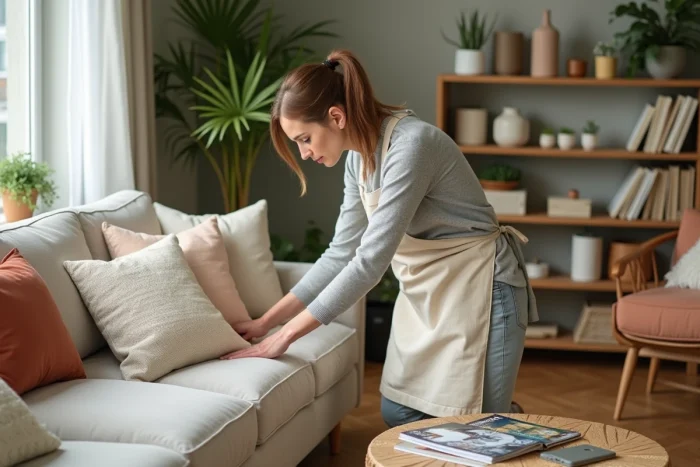
Textiles play a role comparable to that of a light insulation layer. A dense rug placed on an uninsulated floor reduces the sensation of cold upon contact. Thick lined curtains, closed at night in winter, limit heat loss through single or old glazing.
Blinds and Sheers as Thermal Regulators
In summer, a light sheer reflects a significant portion of solar radiation without plunging the room into darkness. This approach complements public aids like MaPrimeRénov’ (enhanced since 2024) that finance structural insulation. Combining textile insulation and building insulation yields the best results in terms of comfort and energy bills.
We observe that wall hangings are making a comeback in design projects, not as a trend, but because they add thermal mass to cold walls. A north-facing wall dressed in thick wool or linen drapery provides a noticeably different comfort level than a bare painted wall.
Reversible Layout for Multifunctional Living Spaces
The ongoing rise of remote work in France, documented by Dares in its 2024 study, is transforming the needs of interiors. A room often needs to serve as an office in the morning, a living room in the afternoon, and a dining room in the evening. Fixed solutions (a massive desk in a corner, a full-length wall bookshelf) no longer meet this reality.
Mobile partitions and foldable desks are technical responses to a domestic ergonomics problem. A foldable tabletop fixed to the wall frees up the entire floor space once folded away. An acoustic partition on wheels isolates a workspace without structural modifications to the home.
Selection Criteria for Reconfigurable Furniture
A modular piece of furniture must meet three conditions to be durable: a structure sufficiently rigid to withstand daily opening and closing cycles, fixings compatible with the type of wall (plasterboard, brick, concrete), and a folded size that does not exceed the depth of a standard shelf.
- Hybrid seating (a rigid pouf convertible into a coffee table, a bench with integrated storage) is suitable for small living spaces where every square meter counts
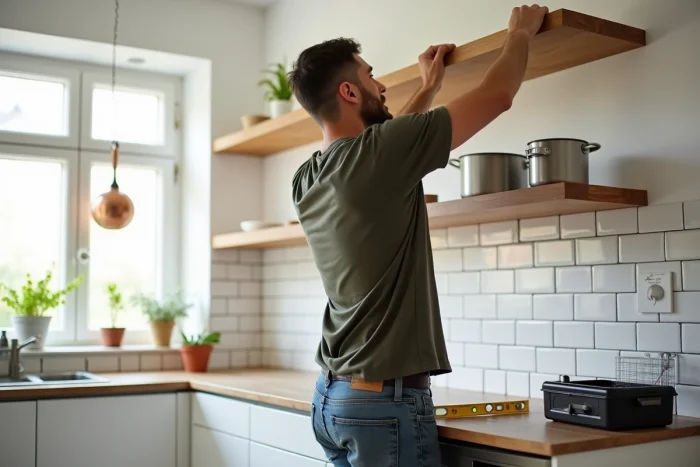
- Wall-mounted suspension rails allow for moving shelves and accessories without drilling new holes, preserving the walls and facilitating reconfigurations
- Articulated arm or clamp lamps are a better alternative to traditional desk lamps: they adapt to usage and free up the work surface
Natural and Artificial Light: Deciding Based on Room Orientation
A south-facing room receives intense direct lighting that warms surfaces and fades fabrics. Installing a cool white light fixture in this space creates an aggressive atmosphere. In this case, we recommend LED bulbs with a color temperature between 2,700 and 3,000 K to balance daylight without duplicating it.
Conversely, a north-facing room, which is darker, benefits from receiving more neutral lighting (around 4,000 K) combined with reflective surfaces. A mirror placed opposite the window reflects natural light deep into the room, but its effectiveness depends on distance: beyond three meters, the gain becomes negligible.
Layering Light Sources
A single ceiling light produces flat lighting that flattens volumes. Three levels of lighting (general, functional, ambient) are sufficient to structure a space. The functional level (reading lamp, worktop spotlight) is the one that most improves daily comfort, as it concentrates light where the activity takes place.

The real improvement of a home’s comfort relies on precise technical choices: the composition of decorative materials, the placement of furniture in relation to air and light flows, and the ability of spaces to change function. These levers, less visible than a change in wall color, are what sustainably transform the quality of life in an interior.