A poorly chosen accessory can weigh down a silhouette faster than a badly cut garment. The selection of fashion accessories is based on specific technical criteria (proportions, materials, finishes) that most guides gloss over in favor of generic lists. We will detail the parameters that truly make the difference between an accessory that structures a look and a decorative addition lacking coherence.
Proportions and volumes: calibrating an accessory to your silhouette
An oversized bag flattens a slender silhouette. A too-fine piece of jewelry disappears on a broad bust. The proportion relationship between the accessory and the body is the first filter for selection, even before color or style.
For a belt, the width dictates the visual effect. A belt less than two centimeters wide slims the waist without marking it, while a belt wider than five centimeters segments the bust and hips. The choice of width depends on the waist-hip ratio, not on a seasonal trend.
We find the same logic with bags. A crossbody bag whose base falls below the hip visually elongates the torso. Worn higher, it shortens the bust but broadens the shoulders. This positioning is adjusted by the length of the strap, a detail that can often be fine-tuned with a rigorous selection, like that offered on the Cœur 2 Mode website, where each piece is described with its exact dimensions.
Sunglasses follow the same rule of proportion. The frame should match the width of the face without exceeding it by more than half a centimeter on each side. A frame that is too narrow constricts the features, while a frame that is too wide overwhelms the gaze.

Materials and finishes: what distinguishes a durable accessory
The quality of an accessory is first seen in its finishes, not in its price. A gold-plated piece of jewelry with a too-thin layer tarnishes within weeks. A vegetable-tanned leather bag develops a patina over time and gains character, while coated faux leather cracks within the first few months.
Consumer expectations are evolving towards repairable and traceable accessories. The McKinsey report The State of Fashion 2025 highlights the rising demands for differentiation and utility value in fashion purchases. In practical terms, this means that a silk scarf with a hand-rolled hem can be resold or passed down, whereas a polyester scarf ends up forgotten in a drawer.
Checkpoints before purchase
- Stitches: regular, without pulled threads, with tight stitching in tension areas (bag handles, belt attachments)
- Clasps and buckles: weight in hand, fluidity of the mechanism, absence of play. A clasp that squeaks at purchase will break in six months
- Lining: present in a quality bag or pouch, it protects items and prevents deformation
- Metal plating on jewelry: asking for the thickness of the layer (expressed in microns) helps anticipate lifespan
For belts, the thickness of the leather and the type of tanning determine rigidity. Full-grain leather maintains its shape even after years of daily use. Split leather, which is less expensive, deforms and marks at the buckle holes.
Color and style coherence: building a look with accessories
An accessory is not chosen in isolation but in relation to the outfit’s palette. We recommend limiting metallic finishes to a single shade per look (gold, silver, or copper). Mixing metals creates a visual break that fragments the silhouette, unless there is a deliberate mastery of contrast.
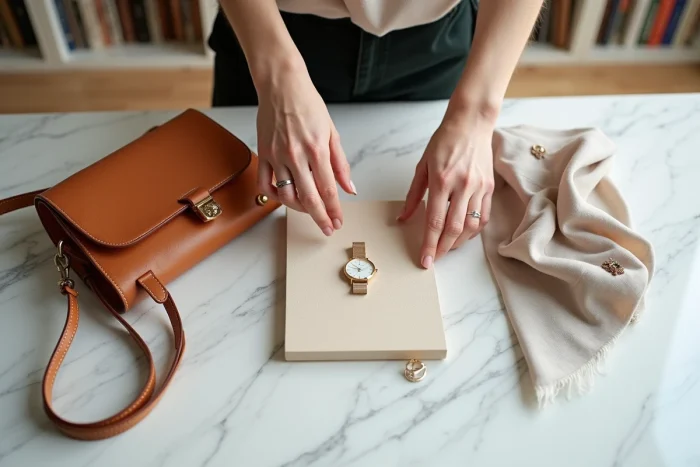
The rule of tonal harmony works better than one might think with accessories. A cognac bag, a honey belt, and tortoiseshell glasses form a coherent ensemble without being uniform. This tonal approach adds more depth than a statement accessory isolated on a neutral outfit.

The common mistake of a total monochrome look
Matching the color of the bag exactly to the shoes creates a dated effect. Harmony comes from tone, not from exact matching. Two leathers from the same color family but with different textures (grained and smooth, matte and glossy) create a much more interesting visual dialogue.
Jewelry plays a role of punctuation. Structured earrings are enough to elevate a look when the rest of the outfit remains understated. Accumulating necklaces, bracelets, and rings dilutes attention. The question to ask is: which part of the body should draw the eye first?
Fashion accessories and European product traceability
The European regulatory framework is tightening on the sustainability and traceability of fashion products. This evolution directly affects accessories, particularly leather goods, costume jewelry, and sunglasses. Brands will need to provide more information about the origin of materials and manufacturing conditions.
For the informed consumer, this translates into an advantage: product sheets will become more transparent regarding actual composition. A scarf labeled “silk” without specifying percentage or origin will become increasingly suspect. Customized accessories and those produced in short supply chains are gaining ground against standardized pieces, a trend documented by PwC in its Voice of the Consumer 2024 report.
This demand for traceability also modifies the second-hand market. An accessory with known provenance and materials resells better and retains its value longer than an anonymous piece.
The choice of a fashion accessory is less about a crush than about a technical reading: proportions suited to the morphology, materials whose finish is verified, color coherence with the rest of the wardrobe. A single well-calibrated accessory transforms a basic outfit into a constructed silhouette, while five poorly matched pieces create visual noise.